“Entry level, 1 to 2 years of experience required.” If you are trying to start a medical billing career, you have probably seen that line more times than you can count. It feels impossible: you need experience to get the job, and the job to get experience.
The good news is that billing managers are not really asking for years on a payroll. They want to know that you can work claims without being taught every click. You can prove that before your first job. This guide explains what hiring managers look for, how to build hands-on experience on your own, and how to show it on your resume.
What “experience” really means to a billing manager
When a billing manager interviews a new biller, they are listening for a few things:
- Do you understand the claim cycle? From registration and eligibility through coding, submission, payment and follow-up.
- Can you read a remittance? Knowing the allowed amount, the contractual adjustment and what the patient owes.
- Do you know why claims fail? Rejections for bad data, denials for coverage, coding or authorization problems.
- Can you fix things? Correcting a claim, resubmitting it and appealing when needed.
- Do you speak the language? Terms like CARC, ERA, COB, timely filing and A/R aging.
None of these require a paycheck. They require practice on realistic screens.
Four ways to build billing experience without a job
1. Earn a credential, but don’t stop there
Certifications such as the CPC (from AAPC) or CBCS (from NHA) show that you know the rules. Many employers like them. But a credential on its own does not show that you can work in a system, so pair your studying with hands-on practice.
2. Practice in a training EHR with a clearinghouse
This is the fastest way to get the “hands-on” part. A training EHR gives you a fictional clinic where you can register patients, verify insurance, code visits and submit claims, without any real patient data.
The key is a system that goes past the chart. Fernwell Training EHR includes a practice clearinghouse called Claimstead, so your claims are acknowledged, accepted or rejected, paid or denied, and come back as ERAs you post yourself. (Fernwell is made by the team behind MedBillGuide.com.)
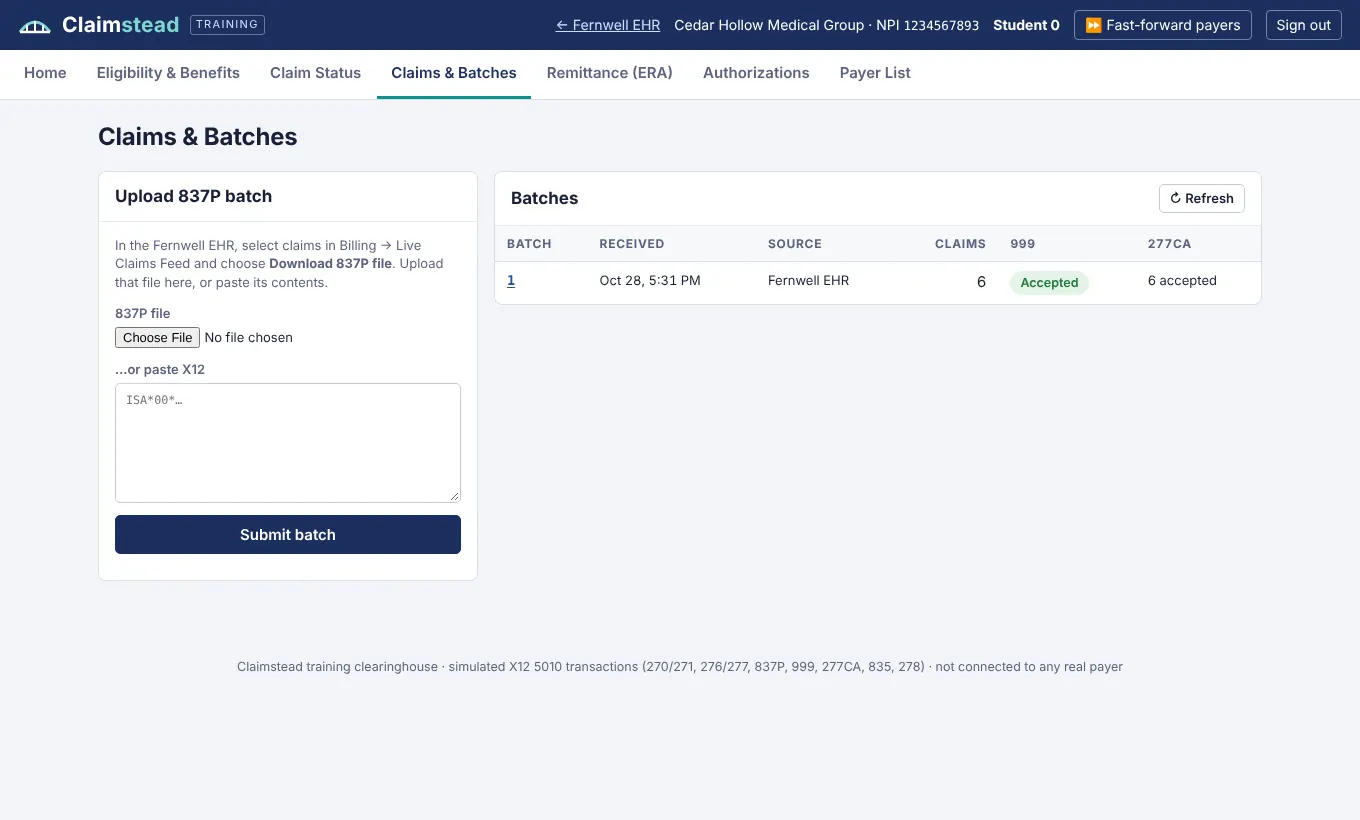
With it you can practice:
- Eligibility checks and fixing member ID errors.
- Building claims with ICD-10-CM, CPT, modifiers and authorizations.
- Submitting 837P batches and reading 999 and 277CA responses.
- Posting ERAs with CARC and RARC codes.
- Working denials, sending corrected claims and billing secondary insurance.
- Patient statements and A/R follow-up reports.
Each step has a short lesson in Fernwell’s Learning Center and a matching practice task, plus a glossary of more than 150 billing terms.
3. Volunteer or take a front-desk role
Front-desk, scheduling and patient-access jobs are often easier to land and teach you registration, insurance verification and collections. Many billers start there and move to the back office within a year.
4. Learn from real-world billing problems
Read payer policy updates, follow billing forums and read guides on common denials. When you meet a new denial code in practice, look it up and write down what fixed it. That notebook becomes your interview prep.
A 30-day hands-on plan
| Week | Focus | Goal by Friday |
|---|---|---|
| 1 | Front end: scheduling, registration, eligibility | Register 5 patients and verify coverage for each |
| 2 | Coding and charge entry | Code and scrub 10 visits with correct modifiers |
| 3 | Claims and remittance | Submit claim batches and post every ERA |
| 4 | Denials, secondary claims and A/R | Correct 3 denied claims, bill 2 secondaries, run an aging report |
Keep a simple log of what you did each day. You will use it for your resume.
How to put practice work on your resume
Hiring managers respond to specifics. Instead of “familiar with billing software,” write lines like these:
- Completed 40+ practice claims end to end in a training EHR and clearinghouse, from eligibility verification through ERA posting.
- Resolved simulated rejections and denials (invalid member ID, missing authorization, coding edits) and submitted corrected claims.
- Posted ERAs with CARC/RARC codes and billed secondary payers under coordination of benefits.
Label it clearly as training or practice work. Honesty matters, and specific practice is still impressive.
Interview questions you will be ready for
- “What is the difference between a rejection and a denial?”
- “Walk me through what you do when a claim is denied for CO-197.”
- “How do you know what the patient owes from an ERA?”
- “When would you send a corrected claim instead of a new one?”
If you have worked these situations in practice, you can answer with a real example instead of a definition.
Get started today
You don’t have to wait for someone to give you experience. Start building it this week with a practice EHR for medical billing, and walk into your next interview able to show what you can do.